

Here’s something worth knowing before any sewer decision gets made: the size of the recommended fix and the size of the actual problem don’t always match.
A homeowner calls about a backed-up drain. By the end of the day, someone has handed them a quote for a full sewer line replacement, a torn-up yard, and a number that makes their stomach drop.
Sometimes that’s the right call. Often, it isn’t. And most homeowners have no way to tell the difference.
That gap is what this guide is here to close. The principle behind it is simple: sewer decisions should be driven by evidence, not the worst-case scenario.
A reliable local plumbing service in Santa Rosa fields these questions constantly, and the principles hold true wherever you are in Sonoma County. By the end, you’ll know the common issues, the warning signs, what needs a repair versus replacement, and when a second opinion is worth your time.
Key Takeaways
- Inspect before you decide. A camera inspection should drive every meaningful sewer decision. Recommendations made without one are guesses.
- The fix should match the problem. Cleaning, repair, and replacement solve different things. Defaulting to the biggest job is rarely the smartest move.
- Symptoms point to a problem, not a solution. Backups and smells tell you something’s wrong, not what the fix should be.
- Trenchless repair is excellent in the right situation, but not every line qualifies. The inspection decides.
- A second opinion is normal and reasonable, especially before a large replacement.
- Local experience matters because Sonoma County’s older homes, soils, and aging sewer infrastructure shape what goes wrong and how to fix it.
What’s Been Building Up Underground
Most homeowners never think about their sewer line until it stops cooperating. That’s normal. It’s buried, out of sight, and quietly doing its job for years. So, when something goes wrong, the situation feels sudden and confusing, even though the underlying cause has most likely been developing for a long time.
Sewer problems are rarely random. They follow patterns tied to the age of the home, the material of the pipe, the trees in the yard, and how the line was installed decades ago.
Older neighborhoods in Santa Rosa and established homes throughout the county often have sewer lines that were put in generations ago. That’s not a problem in itself. It just means the failure modes can become predictable once you know what to look for.
The Most Common Sewer Line Problems
- Root intrusion. Tree and shrub roots are drawn to the moisture and nutrients in sewer lines. They work their way in through tiny cracks or joints, then grow. This is one of the most common issues in older, tree-lined neighborhoods.
- Pipe corrosion and age. Older cast iron corrodes from the inside over decades, narrowing the pipe and catching debris. Clay pipe cracks at the joints. Older fiber pipe can deform with age.
- Bellies (low spots). Over time, sections of pipe can sag, creating a low point where waste and water collect instead of flowing through. Bellies cause recurring backups that cleanings never fully resolve.
- Cracks and breaks. Ground movement, settling, and age all stress a pipe. Cracks let roots in and let water out.
- Blockages and buildup. Grease, debris, and foreign objects can clog a line that’s otherwise in good shape.
- Joint separation. Where pipe sections meet, they can shift apart over time, creating gaps that leak and invite roots.
Worth Knowing: The same symptom can come from any of these causes. That’s exactly why guessing at the fix without looking inside leads to wasted money and repeat problems.
Warning Signs to Pay Attention To
Plumbing usually warns you before it fails outright. Learning to read those signals is the difference between catching a problem early and dealing with sewage on the bathroom floor.
Signs That Point to a Sewer Line Issue
- Multiple drains acting up at once. When more than one fixture is slow or backing up, the problem is usually in the main line that everything shares, not in a single fixture.
- Gurgling sounds. Toilets or drains that gurgle when another fixture runs suggest air trapped by a partial blockage in the main line.
- Sewer smells indoors or in the yard. Persistent odors can signal a cracked line, a failed seal, or a venting issue.
- Slow drainage throughout the house. Whole-house slowness points to the main line. A single slow sink usually doesn’t.
- Backups in the lowest drains first. A ground-floor shower, garage, or basement drain that backs up is a classic main-line warning.
- Unusually lush or wet patches in the yard. A leaking sewer line can feed a green stripe of grass or a soggy spot above the pipe.
- Sewage backing up into tubs or showers when you flush. One of the clearer signs of a main-line problem that needs prompt attention.
A single warning sign might be minor. Several of them together usually mean a real main-line issue is in play. The question at that point isn’t whether something’s wrong. It’s what’s wrong and how much of the line is affected?
A good rule of thumb: don’t wait for a full backup to take these seriously, but don’t panic either. Most sewer issues are not the kind of emergency that requires a decision in the next hour. They’re the kind that rewards a careful, informed decision.
Always Ask for a Camera Inspection
If there’s one idea to take from this entire guide, it’s this: the camera inspection comes first.
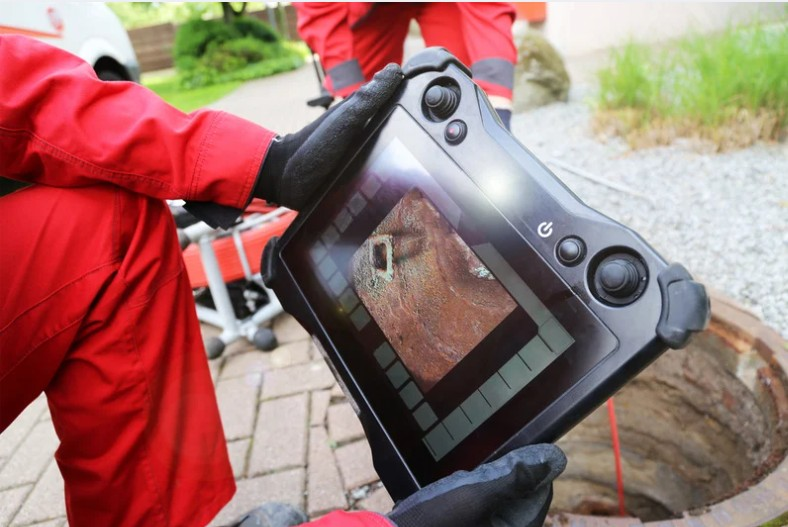
A sewer camera inspection sends a small, flexible camera through the line so the homeowner and the plumber can see exactly what’s happening inside, in real time. It shows where the problem is, what’s causing it, how long the affected section is, and what condition the rest of the line is in.
Everything else in this guide depends on this one step. Choosing between cleaning, repair, and replacement is impossible without knowing what’s actually going on. A recommendation made without an inspection is, at best, an educated guess.
What A Good Inspection Includes
- A real diagnosis, not a verbal hunch
- The location and length of the damage
- The cause, whether that’s roots, a belly, corrosion, a crack, or a simple clog
- The condition of the rest of the line, which often matters more than the damaged section
- Footage you can see and keep, so the decision is informed and yours
The smart move is to watch the footage with the plumber and ask for a copy. Any plumber confident in their diagnosis will be glad to show what they’re seeing.
Instead of asking “how much will the repair cost?” start with “what does the camera show?” The first question leads to a number. The second leads to the right number.
When a Drain Cleaning is Enough
Not every sewer problem needs a repair. A good portion of these calls are resolved with a cleaning, and a trustworthy plumber will say so rather than sell something bigger.
Drain cleaning clears what’s blocking the flow inside a pipe that’s still structurally sound. If the line is in good shape and the issue is buildup or a blockage, cleaning is the right level of fix.
Drain Cleaning is Likely Enough to Fix the Issue When:
- The camera shows a sound pipe with a localized blockage
- The issue is grease, debris, or minor buildup
- There’s no structural damage, belly, or significant root intrusion
- It’s a first-time clog rather than a recurring one in the same spot
For tougher buildup, scale, or root intrusion in a pipe that’s otherwise healthy, hydro jetting uses high-pressure water to clear what a standard cleaning can’t. It’s still a cleaning method, not a repair, but it handles a lot more.
When the same drain clogs again every few weeks or months, repeated cleanings are treating a symptom while the real cause sits underground. That’s the point where an inspection earns its value, because a recurring clog often signals something structural that cleaning will never fix.
When a Repair is the Best Choice
Between “just needs a cleaning” and “needs full replacement” sits a large middle ground that often gets skipped in the rush to quote a big job. That middle ground is repair.
A sewer repair fixes a specific problem in a specific section of the line, leaving the rest of the healthy pipe in place. When the damage is contained, this is frequently the smartest and most cost-effective path.
Repair is Often the Right Call When:
- The damage is localized to one section of an otherwise healthy line
- A crack, a separated joint, or a single area of root intrusion is the issue
- The rest of the line is in good condition on the camera footage
- The problem can be addressed without disturbing the entire pipe
A bad 8-foot section in an otherwise solid 60-foot line usually does not justify replacing the whole thing.
Homeowners are sometimes quoted for full replacements when a targeted repair would have solved the problem and saved them thousands. This is exactly the kind of situation a second opinion is built for.
When Replacement is Necessary
Much of this guide encourages homeowners to question oversized recommendations. So, it’s just as important to be clear about the other side: sometimes a full sewer line replacement is exactly what the situation calls for, and anything less would be a waste of money.
Replacement is the Best Course of Action When:
- Aging clay, cast iron, or older fiber pipe is failing along most of its length
- There’s heavy root intrusion in multiple sections
- The line has significant bellies, separations, or collapse across its length
- The pipe has been spot-repaired several times already
- The camera shows widespread deterioration, not isolated damage
In these cases, replacement isn’t the expensive option being pushed onto anyone. It’s the long-term solution that ends the cycle of repeat repairs. The key, again, is that the recommendation is backed by what the camera is showing and explained in a way that’s easy for the homeowner to follow.
A trustworthy replacement recommendation always comes with the “why”. If someone can show the footage and walk through why a repair won’t hold, that’s a recommendation worth trusting. If they can’t, that’s a signal to slow down.
The Benefits of Trenchless Repair
When replacement is necessary, the next question most homeowners ask is whether they can avoid tearing up the yard. That’s where trenchless methods, often called no-dig repair, come in.
Trenchless work fixes or replaces a sewer line through one or two small access points instead of a long open trench. For Sonoma County homeowners who care about their landscaping, driveways, and hardscaping, it can be a genuinely better experience.
The Two Main Trenchless Repair Methods
- Pipe lining (CIPP): A resin-coated liner is inserted into the existing pipe and cured in place, creating a new, seamless pipe inside the old one. This suits pipes with cracks, leaks, or moderate corrosion that still hold their shape.
- Pipe bursting: A new pipe is pulled through the path of the old one while a bursting head breaks the old pipe apart. This suits pipes too deteriorated to line, or when a size upgrade is wanted.
What Trenchless Repair Offers:
- Minimal disruption to landscaping and structures
- Faster completion, often within one to two days
- Durable, long-lasting materials
- Lower restoration costs, since there’s far less to put back together
Not every line qualifies for trenchless. A line that has fully collapsed or shifted badly out of alignment may not provide the intact path that lining or bursting needs. In those cases, traditional excavation is sometimes the only way to do the job right. And the only way to know which camp a line falls into is, once again, the camera inspection.
When to Get a Second Opinion
Here’s what a lot of plumbers won’t say plainly: getting a second opinion on a major sewer project recommendation is not insulting, and it’s not a waste of time. For a job that runs into the thousands, it’s just the smart thing to do.
Signs it’s Worth Getting a Second Opinion
- A full replacement was recommended without a camera inspection
- The plumber won’t share the inspection footage
- There’s pressure to decide today
- No repair, hydro jetting, or trenchless alternatives were mentioned
- The estimate is vague or verbal rather than detailed and written
- Something simply doesn’t add up when you ask “why”
A plumber confident in their diagnosis welcomes a second opinion.
Plenty of second-opinion visits confirm the original recommendation was sound. Others reveal that a far smaller fix would solve the problem. Either way, the homeowner walks away knowing they made the right call. That peace of mind is worth a short appointment.
Benefits of Hiring a Local Plumber
Local experience genuinely changes the quality of a sewer diagnosis.
A plumber who works in Sonoma County neighborhoods every day knows the housing stock, the common pipe materials in older Santa Rosa homes, the soil conditions that cause stress on the lines, and the local permit process for sewer work. That familiarity leads to more accurate diagnoses and fewer surprises mid-project.
A local plumber is also more directly accountable. The homeowner works with the same small team from inspection to completion, not a rotating crew dispatched from a regional call center. If a follow-up is needed, the path is short.
The best sewer outcomes tend to come from a plumber who knows the ground they’re digging in.
How to Get Started
For anyone staring down a sewer problem right now, here’s how to put this guide to work:
- Start with the warning signs. Note how many drains are affected and whether the issue keeps returning. That tells you a lot before anyone arrives.
- Insist on an inspection. Don’t approve a major repair or replacement without seeing the camera footage.
- Match the fix to the problem. Ask whether cleaning, repair, or trenchless options are viable for the specific situation, and why or why not.
- Get the estimate in writing. Detailed line items, scope, and timeline. A verbal number isn’t a plan.
- Get a second opinion if anything feels off. It costs a little time and can save a great deal of money and stress.
Becoming a plumbing expert isn’t the goal. Asking for evidence and matching the solution to it is. That alone puts a homeowner ahead of most people facing the same decision.
What a Trustworthy Plumber Should Do
The information in this guide works best when paired with a plumber who follows a clear, methodical process. Most reputable plumbers already do, and knowing what that process looks like makes it easier to feel confident in the recommendation you receive.
A trustworthy plumber, local or otherwise, tends to share a few habits worth looking for:
- They inspect before they recommend. A camera inspection comes first, so the diagnosis is based on evidence rather than assumption.
- They show their work. The footage gets shared and explained in plain language, and the homeowner is welcome to watch and ask questions.
- They present the full range of options. Cleaning, repair, trenchless, and traditional replacement are all on the table when they apply, with clear reasons for and against each.
- They recommend the fix that matches the problem, even when that’s the smaller, less expensive one.
- They put the estimate in writing and don’t pressure anyone to decide on the spot.
- They welcome a second opinion instead of bristling at the idea.
When a plumber checks those boxes, the homeowner can feel good about the recommendation, whatever it turns out to be. When several of them are missing, that’s reason enough to slow down and get another look.
Move Forward with Confidence
A sewer line problem feels like a crisis when it isn’t understood and like a manageable decision when it is. The best plumbing decisions aren’t made under pressure. They’re made with a clear picture of what’s actually happening and a fix that fits it.
When you’re ready to get that clear picture, Holman Plumbing is here to help. With over 6 years of experience serving Sonoma County homeowners, our team is equipped with the tools and knowledge to help local homeowners make the best decisions for their home with confidence.
Contact us online or call Holman Plumbing at (707) 495-5002 to schedule a sewer camera inspection in Sonoma County.